# DDF Digital Token Economics Update: How Burns Create Scarcity for DDF
[](https://postimg.cc/TKxqsV9h)
<p>Token burns are everywhere on BNB Chain. Most of them are theater — a team burns some tokens from their own allocation, posts a Medium article, and hopes the price moves. DDF Digital is doing something different. Their burn mechanism is tied directly to platform revenue, which means the rate of token destruction scales with actual usage. That's a fundamentally different proposition.</p>
<p> </p>
<h2><strong>DDF Digital: the short version</strong></h2>
<p> </p>
<p>It's a digital asset management platform on <strong><a href="https://dexscreener.com/bsc/0xf730bb272cb8982cae5c003a63326a81d4aaa47e">ARC</a></strong>. Portfolio analytics, automated rebalancing, curated asset recommendations — the tools that institutional players take for granted but retail crypto investors usually piece together from spreadsheets and browser tabs.</p>
<p> </p>
<p>The DDF token unlocks premium features. More users wanting managed crypto exposure means more demand for DDF. Simple supply-demand dynamics tied to something real.</p>
<p> </p>
<p>Despite how far DeFi has come, most people are still tracking their portfolios manually across multiple wallets and protocols. DDF Digital aggregates everything into unified dashboards showing real-time composition, performance attribution, and risk metrics. Just the consolidation alone is worth something if you're spread across a dozen DeFi platforms.</p>
<p> </p>
<h2><strong>How the burn mechanism works</strong></h2>
<p> </p>
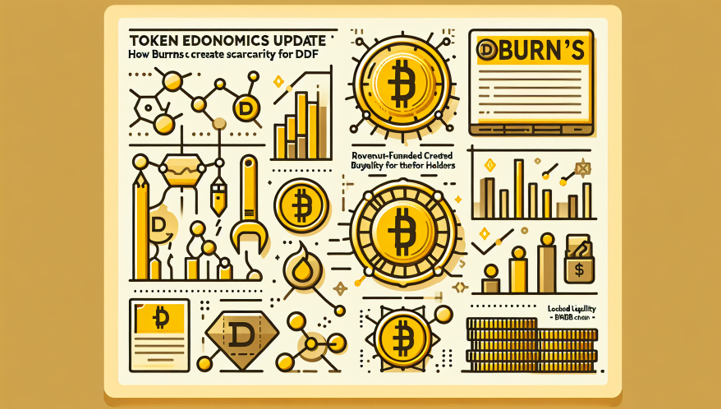
<p>Platform fees come in. A defined percentage goes toward buying DDF tokens on the open market. Those purchased tokens get sent immediately to a burn address. Gone forever.</p>
<p> </p>
<p>Three details that matter:</p>
<p> </p>
<ul>
<li><strong>Revenue-funded buybacks</strong> create consistent buy pressure that isn't dependent on team decisions or treasury allocation votes</li>
<li><strong>Immediate burns</strong> mean purchased tokens never sit in a treasury where plans could change</li>
<li><strong>Regular schedule</strong> tied to fee collection periods makes the deflationary events predictable</li>
</ul>
<p> </p>
<h3><strong>Why the revenue linkage is the whole point</strong></h3>
<p> </p>
<p>Burns funded by actual platform income are sustainable. Burns from arbitrary treasury decisions are not. If DDF Digital gets more users managing more assets, fees go up, buybacks increase, more tokens get destroyed. The deflation rate tracks the platform's success organically.</p>
<p> </p>
<p>For holders, this means their share of total supply grows automatically as the platform grows. No staking required. No action needed. The burn mechanism does it for them.</p>
<p> </p>
<h2><strong>The math compounds</strong></h2>
<p> </p>
<p>Here's where it gets interesting.</p>
<p> </p>
<p>Burn a thousand tokens from a supply of one million — that's 0.1% gone. Burn a thousand tokens from a supply of five hundred thousand — that's 0.2% gone. Same absolute burn, double the proportional impact.</p>
<p> </p>
<p>Each burn cycle hits a smaller total supply, which means every subsequent burn of the same size carries more weight. Over months and years, this compounding creates real supply compression.</p>
<p> </p>
<p>Now add the revenue growth variable. If platform adoption increases, burn volumes go up while the supply they're drawn from goes down. Growth in one metric accelerates impact in the other. Flywheel effect.</p>
<p> </p>
<h2><strong>Locked liquidity backs it up</strong></h2>
<p> </p>
<p>DDF Digital secured its token liquidity through <strong><a href="https://mudra.website">liquidity locker</a></strong>, locking the DDF/WBNB trading pool on-chain. The lock is auditable by anyone.</p>
<p> </p>
<p>Locked liquidity plus systematic burns is a strong combination. The liquidity lock means trading stays functional and protected. The burns mean supply only goes one direction: down. Holders get security and economic advantage without lifting a finger.</p>
<p> </p>
<p>For a platform asking users to trust it with portfolio management, these structural commitments matter. You want confidence that the token providing platform access has its fundamentals locked in — literally.</p>
<p> </p>
<h2><strong>Context on BNB Chain</strong></h2>
<p> </p>
<p>As more protocols launch and more tokens flood BNB Chain, the need for portfolio management tools grows proportionally. Nobody can realistically track and optimize positions across dozens of protocols without an aggregation layer. DDF Digital captures that growing need. The fees funding the burns come from services people genuinely need, not from hype cycles.</p>
<p> </p>
<h2><strong>What to watch</strong></h2>
<p> </p>
<p>Lots of BNB Chain projects have burn mechanics. The difference between sustainable deflation and marketing theater comes down to the revenue source.</p>
<p> </p>
<p>DDF Digital ties burns to platform income. The burns run as long as the platform serves users. For holders evaluating the updated economics, there's really one metric that drives everything else: platform adoption. More users, more fees, more burns, more scarcity. And scarcity paired with genuine demand is the only kind that matters.</p>
<p> </p>